

Electric Vehicle Support Guide
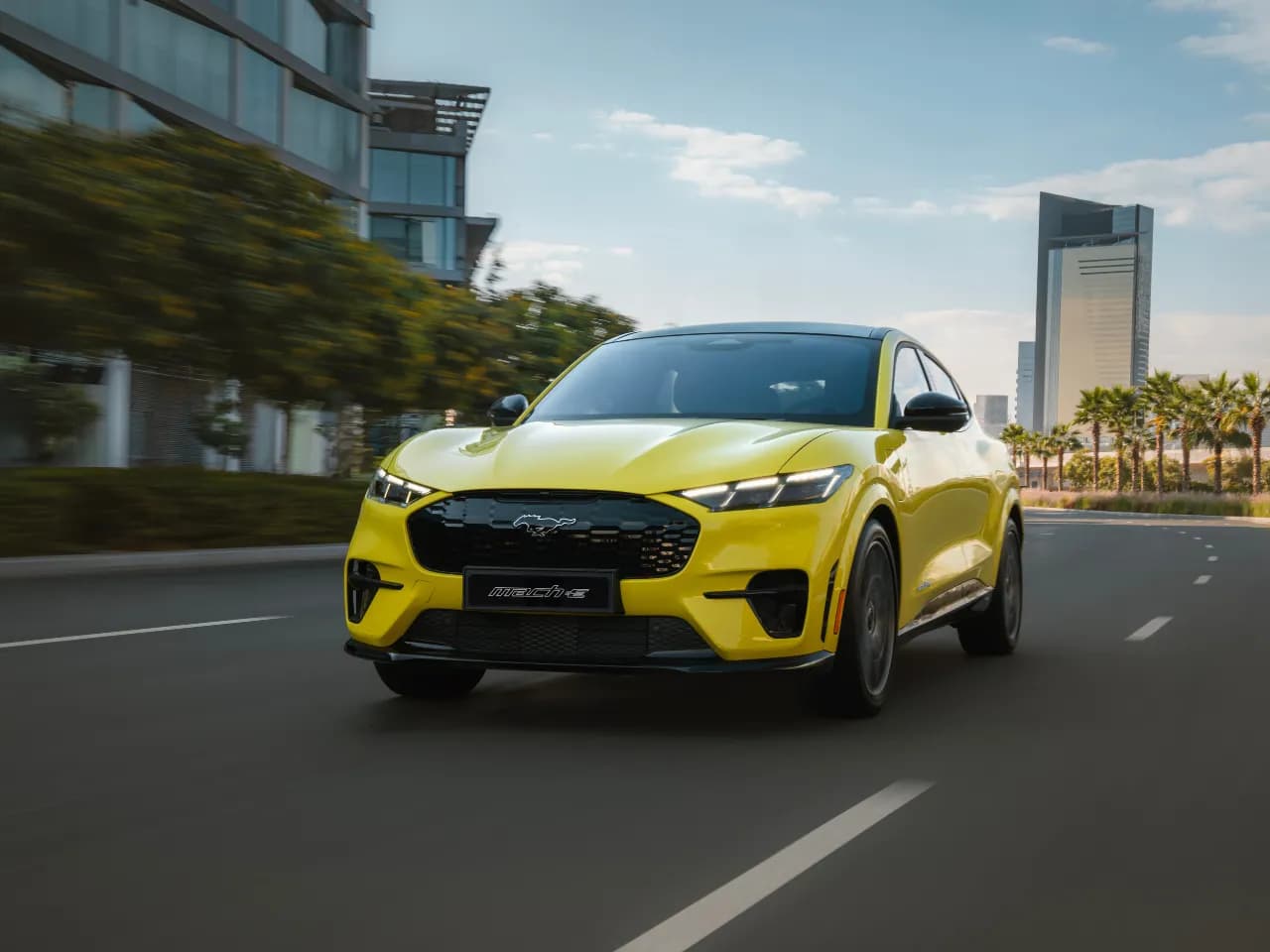
Welcome to Ford Oman's Electric Vehicle Sales Support Guide.
Your comprehensive resource on electric vehicles (EVs). This guide focuses on Battery Electric Vehicles (BEVs) only.
This guide has been created as a central source of truth to equip Ford sales advisors across Middle East markets with the essential information and FAQs they need to confidently guide and assist customers, ensuring that every customer leaves feeling well-informed and prepared for their EV journey.
Contents
- EV Basics
- Key Features and Technologies
- Ford EV Drive Experiences
- Charging your Ford EV
- EV Care and Maintenance
1.EV Basics – How do electric cars work?
An electric vehicle works in many of the same ways your gas-powered vehicle does. In a gas-powered vehicle, a tank of gas represents stored energy potential. In an
all-electric vehicle, similar potential energy is electricity, and the “fuel tank” is a high-capacity battery.
Now, to move, the motor draws power from the bank of batteries to accelerate down the road. And for those of us who really enjoy driving, it often has more lively acceleration than its gas-powered counterpart.
2.Key Features and Technologies
Frunk (Front Trunk)
Frunk is a trunk at the front of your vehicle. The frunk is waterproof and washable, so ideal to hold any muddy sportswear.
Please note: Never leave valuable items in the Frunk of your Ford EV. This can be opened via connecting a 12 volt Jump Box from the front area below the headlight.
E-Latch
Familiarizing yourself with E-latch Instead of traditional door handles, the Ford EV is fitted with an ‘E-Latch’.
When triggered by a button, the doors open electronically by a couple of inches, pushed to this position by a small actuator. A small, fixed grab handle is fitted to each front door, blending in with the window trim.
Infotainment & Connectivity
SYNC 4A
is the integrated in-vehicle communications and entertainment system which can be accessed by the 15.5” touchscreen.
Drive Assists Features
An impressive suite of driver assistance technologies providing improved safety and making your day to day driving effortless. Features like:
- BLIS® (Blind Spot Information System) with Cross-Traffic Alert
- Rear View Camera
- Adaptive Cruise Control with Stop & Go
- Evasive Steering Assist
- Post-Impact Braking
EV Safety Enhancements
Consistent sound for safety
You will notice that your vehicle makes a consistent sound when driving at speeds up to 30kph.
This is a safety feature for driving in an all-electric vehicle, intended to let pedestrians know there is a moving vehicle in their vicinity. When driving at speeds over 30kph, this sound is no longer present as the vehicle will generate enough noise from driving at a faster speed.
Drive away auto lock
This safety feature automatically locks all doors once you accelerate past 30km/h.
3.Ford EV Drive Experiences
Drive Mode
Tailor your Drive Experiences with Mach-E
You can tailor the feel of your drive to the type of journey you will be going on from a choice of 3 modes, each offering a unique experience.
Engage: This is your go-to mode. Balanced for everyday driving, it includes soft blue ambient lighting.
Whisper: Best for slippery conditions, experience a calm, quiet drive with blue ambient lighting for a relaxed feel.
Unbridle: Unleash an aggressive throttle response, stronger deceleration, and sportier steering — all lit in orange ambience.
Selecting your drive mode will adjust the responsiveness of your vehicle, the vehicle sound, and ambient lighting in the vehicle interior.
Each drive experience will provide you with a dynamic and exhilarating ride, with the bonus of zero CO₂ emissions!
Maximising the Drive Range
There are some factors which you could consider in day to day driving to maximise the range:
1.Load: There is plenty of storage space available, however ensure there are no unnecessary heavy items in the load space.
2.Temperature: Batteries perform best at mild external temperatures. Pre-warming the battery before journeys in colder temperatures makes it easier to achieve the maximum driving range.
3.Driving Style: An aggressive driving style, high motorway speeds, and harsh braking will use more battery charge and reduce the level of regenerative braking. Unlike internal combustion vehicles, EVs are significantly more efficient at urban driving speeds than at highway speeds.
4.Auxiliaries: Heating and air conditioning also have a drain on the battery. In cold or hot weather, pre-heating or pre-cooling your EV while still plugged in will reduce the need for air conditioning or heating on your journey.
For drive range, please refer to the vehicle’s specifications for accurate range information.
Driving Range Reset
Sometimes, you may need to clear the Driving Range that is displayed by resetting your EV driving history. This can be done via the SYNC screen. Select Settings > Vehicle > EV Driving History Reset.
Regenerative Braking
Regenerative Braking uses the kinetic energy from braking or slowing down to add energy to the battery for more efficient electric driving. All you need to do is ensure you are braking smoothly to make the most out of this technology.
Regenerative braking will recuperate some energy; however, it is not a method of charging and you will still need to use one of the charging methods.
One Pedal Drive
Allows you to control vehicle speed with the accelerator pedal and reduces the need to use the brake pedal to slow down.
When using One pedal drive, your vehicle will slow down when you release the accelerator pedal and regenerative braking takes full effect. The vehicle can even coast down to a complete stop. You don’t have to use the brake pedal, but you can still use the brake pedal if harsher braking is required.
It can help restore more energy to the battery and provide a solution to constantly switching between pedals in stop-and-go traffic.
Please note this system is an extra driving aid. It does not replace your attention and judgement, or the need to apply the brakes. This system does not automatically brake your vehicle.
4.Charging your Ford EV
Home Charging and Benefit
Charge your EV from the comfort of your home via these 3 methods:
1.Domestic Socket
This is the slowest method of charging your vehicle and takes between 26 – 71h. Other charging methods may be preferred as they offer a faster charge. You will need to purchase a 3 Pin Charging Cable to charge on a domestic socket.
2.Industrial Socket
Using an industrial socket to charge your vehicle is quicker than charging via a domestic socket and takes approximately 10 – 17h.
3.Wallbox
Charging via a wallbox typically takes 7 to 10.5 hours, using the common 7kWh home charging wallbox. Since most charging happens at home, the wallbox is the recommended option for convenient overnight charging. Customers should ensure their home charging setup is inspected by a qualified electrician before using it with their EV.
Benefit of Home Charging
1.Cost Savings
Home EV chargers can be cheaper than public charging stations, but they also save you money in other ways. If you charge more slowly overnight instead of during peak hours in the daytime, it won’t cost much at all during non-peak periods.
2.Convenience
Having a home EV charger is convenient. You can charge your vehicle at home overnight or during the day while at work. Simply plugging in at home means no waiting at a public charging station while your battery recharges.
3.Control over the charging process
The flexibility to plug in your car at any time, day or night, and have it ready to go when you need it.
Public Charging
AC charging speed can be up to 11 kWh and DC charging can be up to 150 kWh.
AC Charging Stations
AC charging stations can usually be found at locations such as by shopping malls, supermarket, public carparks, at the workplace, and in some residential areas. These charging stations are great to use when you need to top your charge whilst out, for example when shopping at a supermarket – some will even offer free charging! It will take around 8-9h (0-100%) to charge your vehicle using an AC Charging Station.
DC Charging Stations (also known as rapid charging)
DC charging stations can be found throughout the country. To find location, please visit (link provided by local market). These chargers will charge your vehicle in around 45 minutes (extended range battery from 10-80% using a 150kW charging station), or 38 minutes (standard range battery).
5.EV Care and Maintenance
Battery Care
Running low on charge
You will receive an orange notification on the digital cluster alerting you of the remaining low-level range, you will have pre-defined. Once you have seen this notification, press “OK” on the steering wheel and the message will disappear.
Charging
You cannot overcharge the battery – the system is designed to stop charging once the battery reaches 100% charge, even if you leave it plugged in. To preserve a healthy battery life, you should use lower power charging as your frequent method of charging (for example your Wallbox or AC public charging instead of DC charging, also when DC charging owners should charge to 80% capacity).
Warranty and Service
- The battery is covered by an 8-year or 160,000km warranty.
- You should service your vehicle every year or 20,000km (whichever occurs first).
- Servicing costs are cheaper than a conventional internal combustion engine vehicle.
Vehicle Maintenance
Electric vehicles should be taken into a Ford Authorized EV dealership annually for a multipoint inspection to evaluate brakes, battery, tire wear, and more. This also includes a tire rotation, fluid replenishment, and cabin air filter replacement.
Frequently Asked Questions
Owning an electric vehicle comes with its perks. You can enjoy lower running costs, reduced maintenance.
